
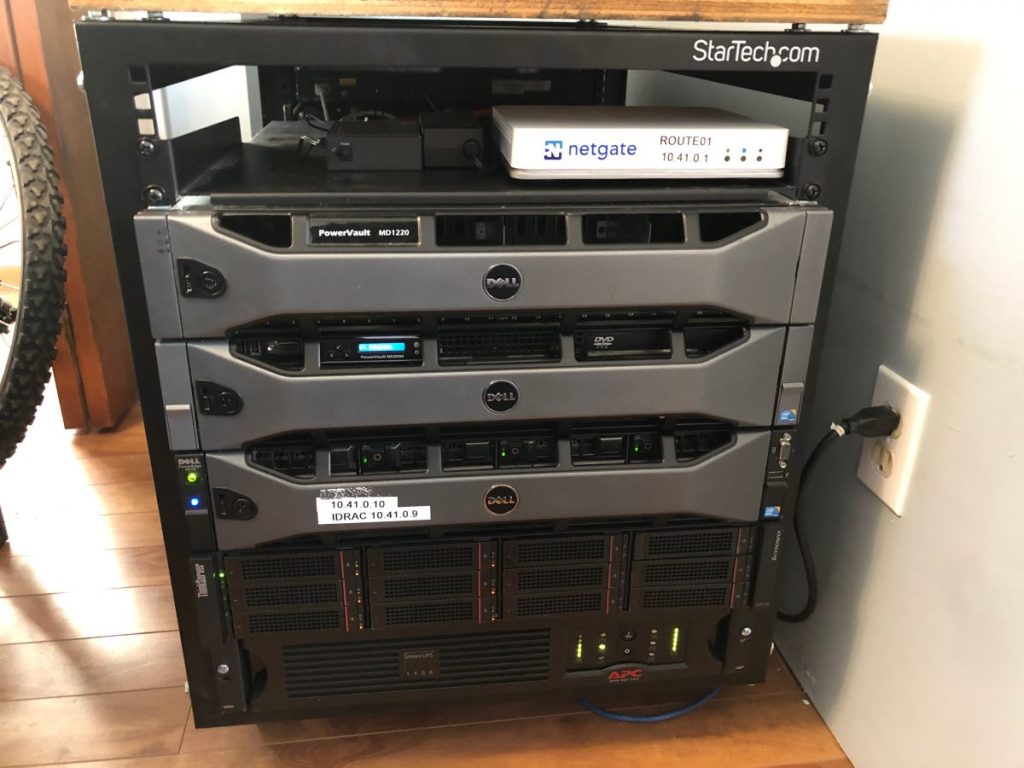
I’ve been using a Dell R510 with unRAID and Docker for almost three years. It might be time for a change. First, where it all started.
The journey started when I needed somewhere to run Plex that wasn’t my MacBook Pro. I’d just freshly discovered the magic that was Roku and Plex Media Server and needed to make it a permanent fixture.
My first home server was a homebuilt whitebox desktop with an AMD A4-5300 (nobody at Canada Computers mentioned transcoding when I told them I was building a Plex server – hmm), 8 GB of memory and four 3 TBish hard drives running Windows 7. I used Free File Sync to keep mirrors of each drive in the event of hard drive failure.
This quickly became an issue as that CPU has a bustling PassMark score of 1246 – this means any more than one transcode was no good. Good thing my workplace was decommissioning an old HP DL360 G5 and offered it up as a freebie. Awesome!

By now I had been reading online about virtualization and learned about ESXI. So, introducing my first enterprise grade server – I had to stash it in the furthest corner of my basement to suppress the ridiculous fan noise of the thing. There were a lot of problems with this setup. The DL360 had 2.5″ drive slots so no bulk storage – hence the multiple NAS units. It was also a HUGE power hog. This setup lasted for a bit and I took the opportunity to introduce Windows Server 2008 to my environment along with a Domain Controller and Active Directory/Group Policy. I also discovered PfSense and added an additional network card to my server with hardware passthrough to run it. I think this was the pivotal moment where the media server started to become a homelab. Cool.
By about the fourth NAS device I realized there was likely a better way of storing the mass amounts of “Linux ISOs ®” I was collecting. Let me explain briefly – every time I ran out of storage I was buying a two bay Synology and configuring the drives in RAID 1. This meant I effectively was only getting 50% of my raw hard drive capacity in usable space. I spent some time online reading about parity and realized that there was a better way. Enter unRAID.
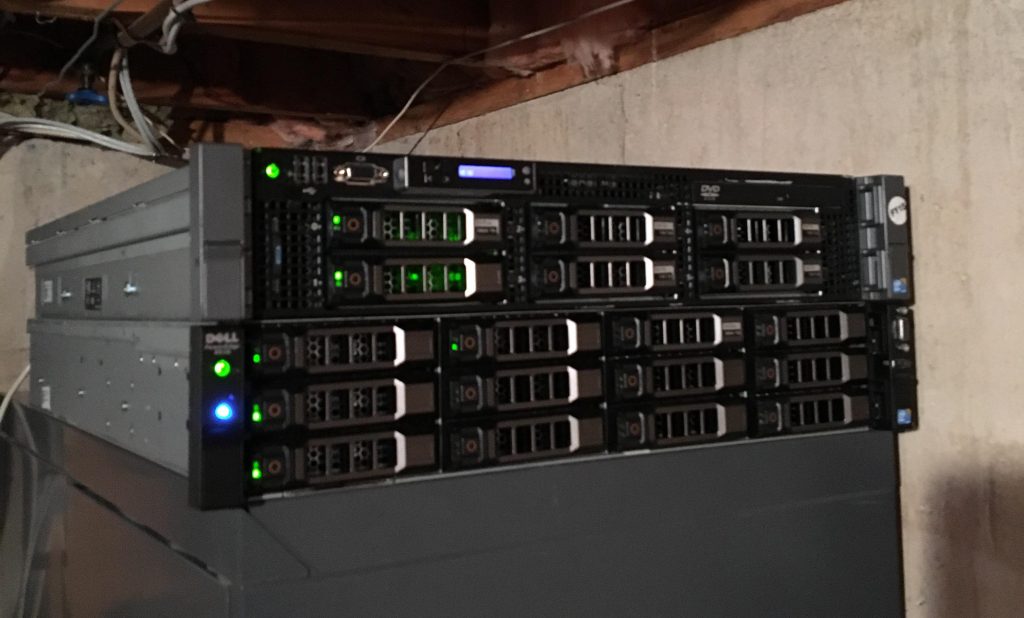
At this point I discovered that eBay has massive amounts of used enterprise grade gear for reasonable prices and purchased an R710 and an R510. I didn’t actually mean to buy both – I put a bid on two and sort of “accidentally” ended up with them both. I think subconsciously it happened accidentally on purpose. Who doesn’t want more servers in their basement?!?! Amiright?
These two were significantly less loud than the DL360 G5 so they got to come back into the “main” area of the basement. Too bad I put them under the main water line. YOLO
So, I was still of the mindset that storage and compute should live on different devices (remember all of the NAS units?) and installed unRAID on the R510 for bulk storage only. Until now I had been running ESXI for virtualization but was a bit frustrated with the limitations on the free version as I had planned to use Veeam for VM backups. I landed on using Hyper-V on the R710 as a solution for this and was pleasantly surprised how well it worked. I spend the weekend migrating my VMs from the old ESXI server and did some rather long-lasting file transfers from the NAS units to my new unRAID storage server and called it a wrap.
So, I’ve got a virtualization server, a storage server, a great firewall running as a VM.. What’s left?
As it turns out, it’s Docker.
So you’re telling me instead of painfully configuring each of the applications I run in Windows VMs I can point to a Linuxserver.io or similar image and it just.. works?
Yes. Plex, Ombi, Radarr, Sonar, Lidarr, Tautulli, Deluge.. all of it.
So that’s what I did, and I did it with unRAID. I finally cracked down and combined storage and compute – and that’s largely what I’ve been running for the last three years. It’s been smooth sailing, but I want to take it to the next level.
So – stay tuned for Part Two!

 Brown.id